Part 2 of 3 · The Guide
If you own a 99-year leasehold property in Singapore — HDB flat, condo, apartment or other private property — there's one number you should never lose track of:
The remaining lease.
Most HDB flats and the majority of private condos and apartments in Singapore sit on a 99-year lease, so the same lease decay principles below apply whether you're holding an HDB flat or a private property. Only a small number of properties are freehold or on longer leases (999-year or similar).
When you bought the property, you probably focused on location, price, floor level, view, facilities and how much the value could grow.
But as the years go by, another factor matters more and more: how many years are actually left on the lease?
Here's a simple principle: don't wait until your property is "old" to start thinking about lease decay. Plan for it while you still have options.
A property doesn't suddenly become a bad buy the moment it hits 60 years remaining — but the economics of owning and eventually selling it do start to shift as the lease gets shorter. So what should you watch for, and what should you do before you get there?
What Is Lease Decay?
Lease decay just means the remaining lease getting shorter over time.
- A 99-year lease starts with 99 years.
- After 10 years, about 89 years remain.
- After 20 years, about 79 years remain.
- After 39 years, about 60 years remain.
The property itself can still be in great condition. The real issue is that the remaining lease matters more and more to future buyers, banks and CPF rules — which is why lease decay is a planning issue, not just a valuation one.
Why 60 Years Remaining Is a Warning Sign
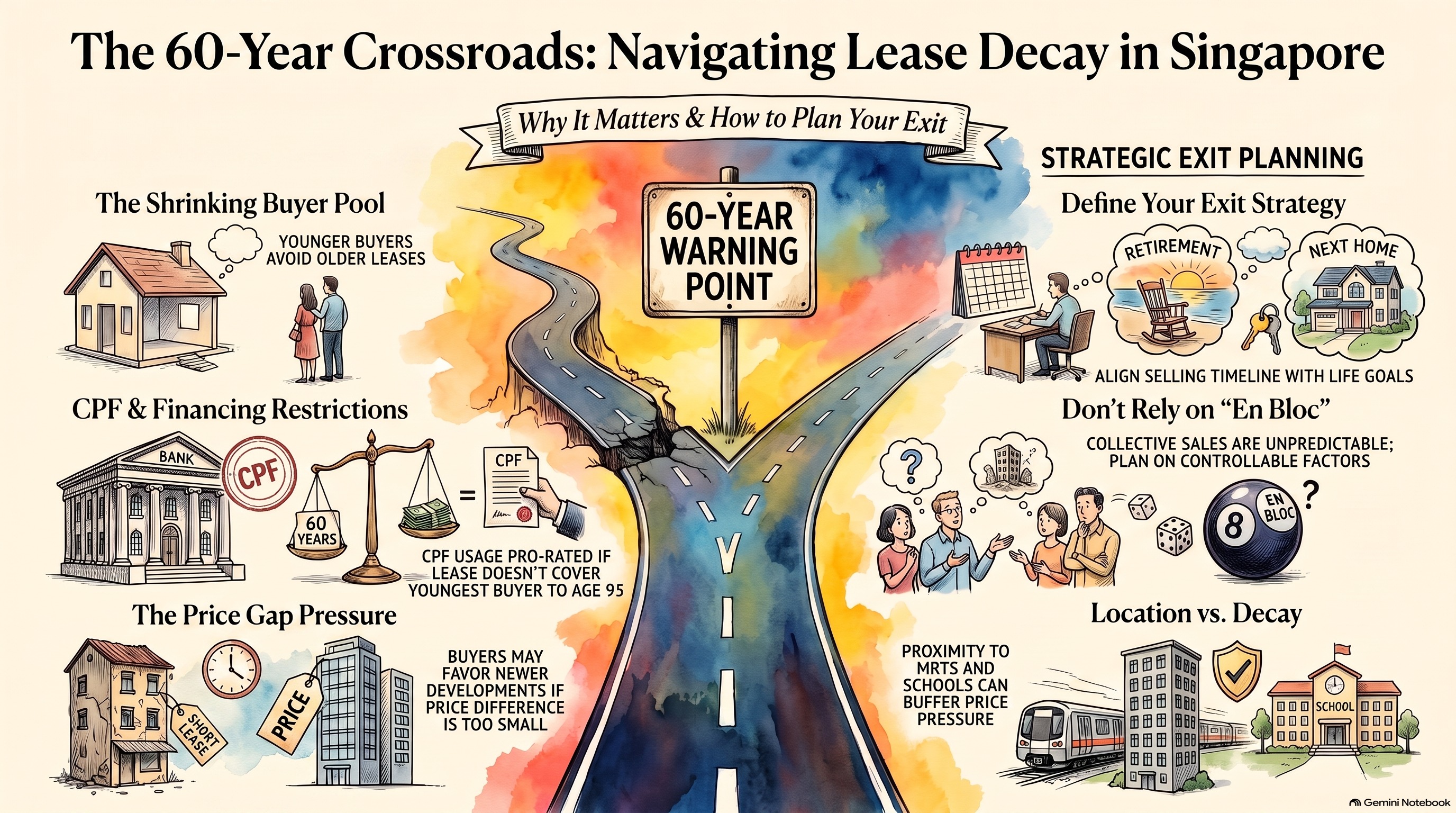
60 years is not a magic cut-off — there's no rule saying a property with 59 years suddenly loses value. But once a property drops into the 50–60-year range, it's worth paying closer attention to how easy it will be to sell later.
Here's why: your future buyer is thinking about the future too. If someone buys your property at 60 years remaining and holds it for 20 years, they'll be trying to sell it with only about 40 years left. Their next buyer may be even more cautious about the lease.
So the real question becomes: who will your future buyer be?
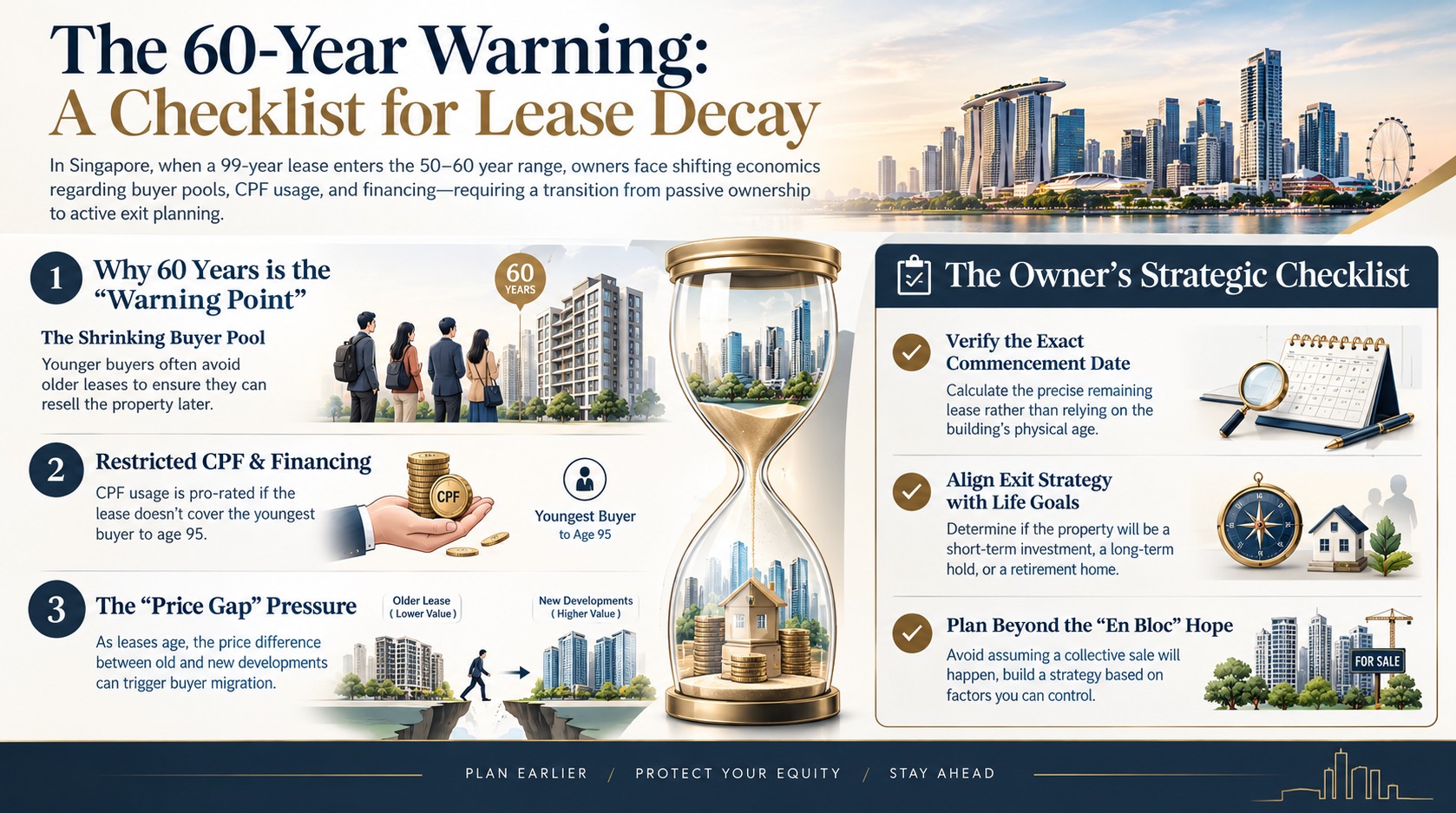
Your buyer pool may shrink. A younger property attracts a wide range of buyers — first-time buyers, upgraders and downgraders, investors, families, and (for private property) even foreign buyers. As the lease shortens, some of these buyers become more hesitant, because they're asking themselves, "Will I be able to sell this easily in 15–20 years?"
This doesn't mean an older leasehold property can't sell. It means pricing and positioning matter more than before — and it applies just as much to a resale HDB flat as it does to a private condo.
Three More Things That Get Harder as the Lease Shortens
1. CPF usage can get restricted.
CPF rules look at your property's remaining lease to decide how much CPF savings can be used:
- If the remaining lease doesn't cover the youngest buyer to age 95, their CPF usage gets scaled down.
- If the remaining lease is under 20 years, no CPF can be used at all.
This matters because a future buyer with less CPF to use will need more cash upfront — which shrinks the pool of buyers who can comfortably afford your property.
2. Financing gets more complicated.
Buyers don't just look at price. They're also asking: how much can I borrow, how long can I finance it for, how much cash will I need, and will the bank's valuation even support this price? These questions get more important as a property ages — so don't assume that because you can sell today, you'll get the same price ten years from now. The lease, market conditions and financing rules can all shift.
3. Price pressure builds gradually.
Lease decay doesn't mean automatic yearly value loss — location still matters enormously. A well-located ageing property can outperform a newer one in a weaker location. The factors that matter most:
- Location and district desirability
- MRT connectivity
- Land scarcity in the area
- Rental demand
Never judge lease decay alone — look at remaining lease + location + price + demand together.
What Should You Do Once Your Property Hits 60 Years?
The question isn't "should I sell right now?" — it's "what's my exit strategy?" That answer depends on your timeline:
- Selling in 3–5 years? Watch your resale performance closely — comparable transactions, buyer demand, competing developments, and how big the price gap is versus newer alternatives nearby.
- Holding for 10–20 years? Think ahead: will your future buyer still be able to finance and afford this property comfortably? That answer shapes whether holding still makes sense.
- Using it as a retirement home? The calculation changes again — weigh location, accessibility, monthly costs, maintenance, your age, and whether you plan to sell later or stay for life.
There's no single right answer. Your property strategy needs to match your life plan.
Should You Sell Before the Lease Gets Too Short?
Don't wait until everyone tells you your property is "old" — by then you're already competing against newer developments with much longer leases. Start monitoring earlier instead. Three things worth checking regularly:
- The price gap — how much cheaper is your property than a newer one nearby? If the gap gets too small, buyers will naturally prefer the newer option.
- The buyer profile — who's realistically buying properties like yours today? Owner-occupiers, investors, families, foreign buyers? This tells you how deep your future buyer pool really is.
- Your replacement property — selling is only half the equation. If you sell and buy again, check the new property's own lease profile too, or you'll just be facing the same issue again later.
5 Things to Do Now to Stay Ahead of Lease Decay
- Know your exact remaining lease. Don't estimate — "my flat is about 40 years old" isn't precise enough. Find the actual lease start date and calculate it properly.
- Review your property every few years. Check recent transactions, competing developments, rental demand, buyer profile, price per square foot, and any upcoming projects nearby — before you actually need to sell.
- Don't ignore maintenance. Ageing facilities and rising repair costs can make buyers cautious, even if the lease itself isn't a dealbreaker. A well-kept older building stays attractive.
- Plan your exit before you need the cash. If you'll eventually need to sell for retirement, your children's education, or your next home, start early — the more time you have, the more choices you have.
- Don't bank on an en bloc sale. It's possible, but it depends on too many factors outside your control to be your entire plan. Plan around what you can actually control.
The Biggest Mistake Owners Make
Waiting too long to start thinking about lease decay. By the time an owner starts thinking "I should sell now because the lease is getting short," the options left are usually far narrower than they would have been a few years earlier. Starting early is always the better approach.