If you're an HDB owner thinking about upgrading to a condominium, there's one question that comes up again and again:
"Should I sell my HDB first, or buy the condo first?"
There is no single answer that works for every upgrader.
Some upgraders are better off selling first, giving themselves a clean financial position before committing to their next home. Others are better placed to buy first, because their circumstances let them manage the temporary cash-flow pressure.
The important thing is not to copy what someone else did.
It is to understand your own finances, timeline and eligibility before making the decision.
Why This Is the #1 Question HDB Upgraders Face
For most HDB owners, upgrading to a condo involves much more than simply comparing the selling price of the HDB with the purchase price of the new property.
There are several moving parts:
- When can you sell your HDB?
- Have you fulfilled your Minimum Occupation Period (MOP)?
- How much CPF can you use for your next property?
- What loan amount can you qualify for?
- How much cash do you have available?
- Will you need to service two properties temporarily?
- How quickly do you need to move?
- What happens if your HDB takes longer to sell than expected?
This is why the starting point should never be the condo. It should be the numbers.
A beautiful condo may look affordable based on the purchase price alone, but the real question is whether the entire transition is comfortable for your household.
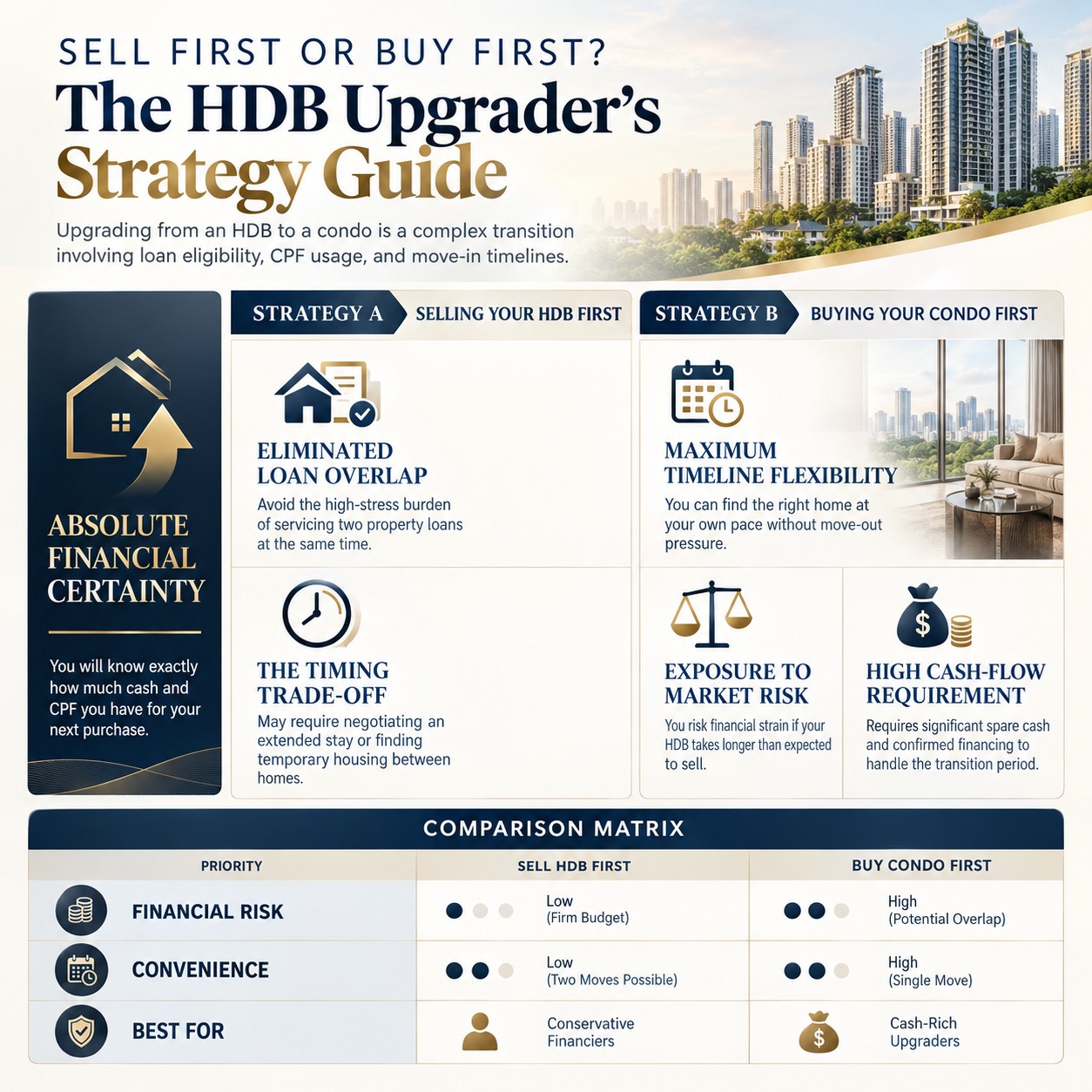
The Case for Selling First: Lower Financial Risk, But More Timing Pressure
Selling your HDB first gives you something that's hard to put a price on: certainty.
Once your HDB is sold, you know exactly how much cash you're working with. There's no guessing, no "what if it takes six more months to sell." You can walk into your next purchase with a firm budget instead of a hopeful one.
This path tends to suit upgraders who:
- Are relying on their HDB sale proceeds to fund a meaningful part of the next purchase
- Would rather not carry two loans, even temporarily
- Have limited spare cash sitting outside their HDB equity
- Simply prefer to know their number before they start viewing units
The trade-off is timing pressure. Once your HDB is sold, the clock starts running on when you need to move out — and depending on the buyer's timeline, that window can feel tight. You may need to negotiate an extended stay, or arrange temporary accommodation while you wait for your next home to be ready. It's manageable, but it does take planning, not improvising.
The Case for Buying First: More Flexibility, But You Need the Cash-Flow to Match
Buying first flips the pressure around. You're not racing a moving-out date, so you can take your time to find the right unit, negotiate properly, and move on your own schedule instead of someone else's.
This path tends to suit upgraders who:
- Have enough cash-flow flexibility to comfortably manage two properties for a stretch
- Have strong, confirmed financing capacity
- Already have a realistic, well-thought-out plan for selling their HDB
- Can handle the temporary financial overlap without it affecting their day-to-day life
The trade-off here is real financial exposure. If your HDB takes longer to sell than expected, you could be servicing two sets of payments for longer than planned. This path only works when the numbers are stress-tested upfront, not assumed to work out.
The Key Questions to Answer Before Choosing a Strategy
Before deciding whether selling or buying first makes more sense, these are the things worth getting real answers to:
- Your HDB status. Have you hit MOP? Are there any restrictions on your timeline? Do you have a realistic sense of your selling price?
- Your CPF and cash position. How much CPF have you used on your current flat, and how much is available for the next one? What will you actually have in cash after the sale?
- Your financing capacity. What can you comfortably qualify for, and what would the monthly mortgage look like — not just what a bank says you're eligible for, but what you're actually comfortable paying?
- Your risk tolerance and timeline flexibility. Some households are fine with a bit of overlap and uncertainty. Others want everything locked down before they move. Neither is wrong — but it changes which path fits you.
Only with honest answers to these can anyone give an honest recommendation. Advice to "always sell first" or "always buy first" without asking about your numbers is a guess, not a plan.
A Common Scenario Worth Considering
Take a common scenario: a couple set on buying first because they've found a new launch they love and don't want to lose it. The excitement is understandable.
But once the numbers are actually worked through, it often becomes clear that servicing two loans — even temporarily — would stretch a single income further than most households are comfortable with. It isn't that the condo is unaffordable; it's that the transition itself becomes financially uncomfortable in a way that isn't worth the stress.
In a case like this, a selling-first plan usually works better: listing the HDB with a clear price expectation, negotiating an extended stay with the buyer, and timing the condo purchase around a confirmed sale rather than a hoped-for one. It takes a little more patience upfront, but it keeps every step of the move on solid ground instead of a guess.
That's really the point of going through this properly — not to find the "correct" answer, but to find the one that actually fits your life.
So, Which Path Fits You?
If you take nothing else from this, take this: the right answer depends on your MOP status, your CPF position, your cash reserves, your financing capacity, and how much timing pressure you're personally comfortable with — not on what worked for your colleague, your sibling, or a couple you saw on a property forum.
The fastest way to get clarity isn't to keep weighing "sell first vs. buy first" in the abstract. It's to actually run your numbers.
Let's Work Out Your Numbers Together
If you want a quick starting point, my free HDB Upgrader Checklist walks through exactly the questions above — your HDB status, CPF and cash position, and affordability — and gives you an Upgrade Readiness Score at the end.
From there, you can also check your affordability directly, message me on WhatsApp, or get in touch here and we'll go through your specific numbers together — no obligation, no sales pressure, just a straight conversation about what makes sense for you.